
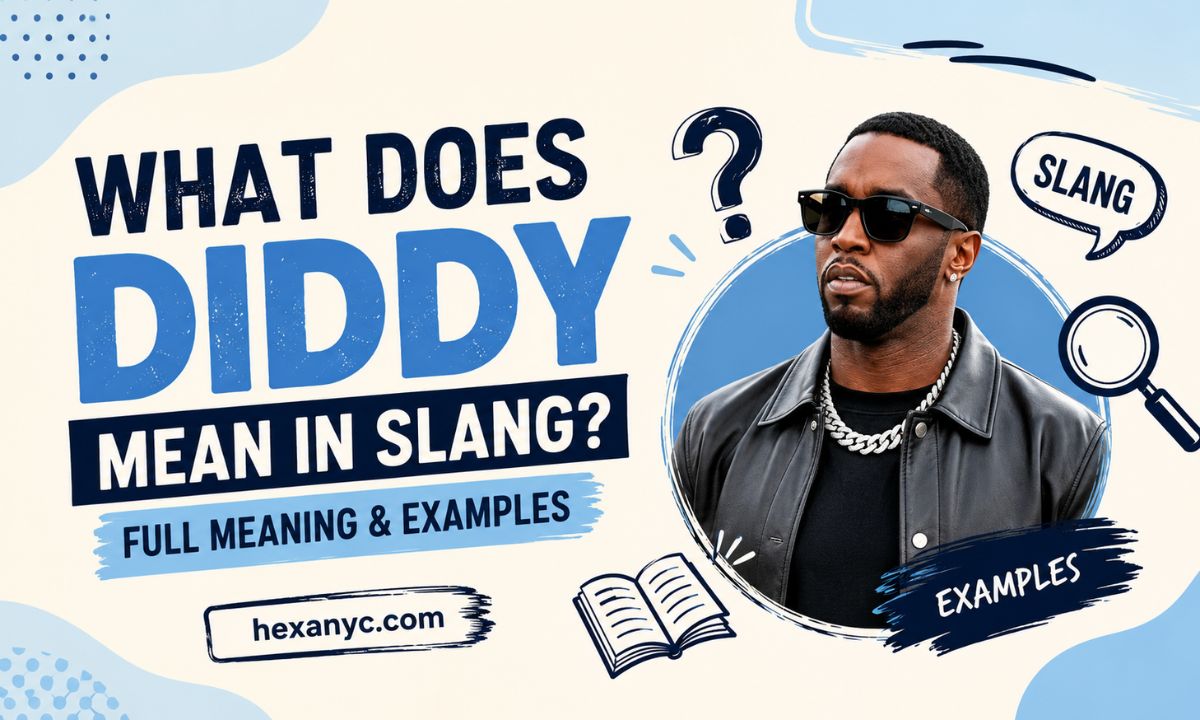

If you have seen “diddy” pop up in a text, a comment section, or a TikTok caption and felt a little lost, you are not alone. Thousands of people search for diddy mean in slang every month because the word shows up everywhere but rarely comes with an explanation.
This guide breaks down every common use of the word, from playful nicknames to meme phrases like “no diddy,” so you can read a chat or comment thread with total confidence. We will cover the origin, the tone shifts, real examples, and how to reply, so by the end you will fully understand diddy mean in slang in every context.
Diddy Meaning in Text, Chat, and Social Media
Diddy Meaning in Text
In everyday texting, “diddy” usually works as a light, informal word. Friends use it as a stand in for buddy, pal, or mate, and it rarely carries a heavy or serious tone. When you ask what diddy mean in slang looks like in a normal group chat, the answer is simple: it is a casual nickname that keeps things friendly.
The word can also describe something small, minor, or a little silly, since “diddy” has older British roots meaning tiny or little. So a text like “that’s such a diddy problem” just means the issue is small.
READ MORE: Opps Meaning in Slang: What It Means and How to Use It
Diddy Slang Meaning
The core diddy slang meaning shifts depending on who is talking and what platform they are on. Broadly, it falls into three buckets:
- A friendly nickname, similar to buddy or pal
- A description of something small or minor
- A reference to rapper and producer Sean “Diddy” Combs, whose public image and recent legal controversies turned his name into shorthand across meme culture
Because the word carries multiple layers, context always decides which meaning applies.
What Does Diddy Mean in Chat?
When people ask what does diddy mean in chat, they are usually reacting to phrases like “no diddy” or “nice try, diddy.” These meme phrases spread quickly through group chats and comment sections in 2024 and have stuck around since. “No diddy” is typically added after a sentence that could sound accidentally suggestive, similar to how “no homo” was once used, and it signals that the speaker did not mean it that way.
Diddy Meaning on Snapchat
On Snapchat, diddy usually shows up in captions or chat replies as a quick, playful tag. Because Snapchat conversations move fast and lean casual, the diddy mean in slang usage here tends to stay light: a nickname, a joke, or a quick meme reference rather than anything formal.
Diddy Meaning on Instagram, TikTok, and WhatsApp
On Instagram, the word shows up most often in comment sections, where users respond to suspicious or exaggerated posts with phrases like “nice try, diddy.” It is a way of calling out something obvious or staged while keeping the tone playful rather than harsh.
TikTok
TikTok is where a lot of modern diddy mean in slang trends actually started or accelerated. Short video culture rewards quick, punchy phrases, and “no diddy” spread across TikTok comment sections and duets rapidly after it first went viral in 2024. Creators often use the term in captions to add a comedic beat to an otherwise normal sentence.
WhatsApp usage tends to be more personal since chats are mostly with friends and family rather than public comment sections. Here, diddy often functions as an inside joke, a callback to a meme both people have seen, or a nickname used between close friends.
Is “Diddy” an Acronym, Short Form, or Something Else?
Diddy is not an acronym. It does not stand for a phrase or hidden set of words. It is simply an informal English word with two separate roots:
- An older British slang term meaning small or little
- A shortened, casual form of the name Sean Combs, who was previously known as Puff Daddy and P. Diddy before shortening his stage name to Diddy in the 2000s
Understanding both roots is key to grasping the full diddy mean in slang picture, since online usage often blends the two.
Tone & Context Variations
Funny Tone
In a funny tone, diddy is used to add humor to an otherwise plain sentence, almost like a verbal wink. “You really tried that, diddy” reads as a light joke between friends rather than an insult.
Sarcastic Tone
Sarcastic use leans on phrases like “nice try, diddy,” which calls out something obviously fake, staged, or unconvincing. The tone stays teasing rather than genuinely angry.
Romantic Tone
Used affectionately, diddy can work as a soft, playful nickname between partners, similar to babe or cutie. In this context it has nothing to do with the celebrity reference and simply adds warmth to a message.
Angry Tone
When paired with sharp punctuation or all caps, diddy can shift toward mockery or genuine irritation. The same word that sounds sweet in one message can sound cutting in another, which is why tone always matters more than the word itself.
Playful Tone
Most everyday use falls here. Diddy is dropped into a sentence purely for fun, often alongside emojis, to keep a conversation light and casual.
Real Chat Examples (Natural & Relatable)
Example 1
“Bro really thought that fit was fire, nice try diddy.”
Example 2
“Stop being diddy about it, it’s not that deep.”
Example 3
“Lol you’re such a diddy sometimes, I love it.”
Example 4
“That ad is so scammy, this is giving diddy party energy.”
Example 5
“I said he’s my best friend, no diddy.”
Example 6
“This is such a diddy issue, don’t stress.”
Example 7
“You tried it, diddy, but I saw right through that.”
Example 8
“Good morning diddy, hope your day’s easy.”
Example 9
“He’s acting diddy again, ignore him.”
Example 10
“That comment section is full of no diddy jokes today.”
Example 11
“Small win but I’ll take it, very diddy of me.”
Example 12
“Chill out, diddy, I was just joking.”
Grammar & Language Role
Part of Speech
Diddy usually works as an adjective (describing something small or playful) or a noun (used as a nickname). It does not function as a verb in mainstream usage, though niche online communities occasionally stretch it that way in dark humor contexts.
Sentence Position
The word typically appears at the end of a sentence as a tag, similar to how “bro” or “fam” gets used, though it can also sit mid sentence as a direct address.
Can It Replace a Full Sentence?
On its own, a simple “diddy” rarely stands as a complete reply. It almost always needs surrounding context or an emoji to land properly.
Tone Impact
Because the word is so flexible, tone changes its entire meaning. The same three letters can read as sweet, sarcastic, or edgy depending on punctuation, emojis, and the relationship between the people texting.
Formal vs Informal Use
Diddy sits firmly in informal language. It has no place in emails, reports, or workplace messaging, and using it in a professional setting risks confusing or alienating the reader.
How to Reply When Someone Says “Diddy”
Funny Reply
“Ha, guilty as charged.”
Serious Reply
“Not sure what you mean, can you explain?”
Flirty Reply
“Aw, you’re sweet for that.”
Neutral Reply
A simple laughing emoji or a short “lol” keeps things easy without over committing to any one interpretation.
Comparison Table With Similar Chat Terms
| Term | Common Meaning | Typical Tone | Best Used With |
| Diddy | Small, playful nickname, or meme reference | Playful, casual, sometimes edgy | Close friends |
| Buddy | Friendly term for a companion | Warm, neutral | Anyone casual |
| Mate | British/Australian term for friend | Friendly, informal | Friends, coworkers |
| No homo | Older phrase clarifying non-romantic intent | Defensive, joking | Peer groups |
| No cap | Emphasizing honesty | Sincere, casual | Any casual chat |
| Bet | Agreement or confirmation | Confident, casual | Friends |
Who Uses This Term?
Age Groups
Younger users, particularly teens and young adults active on TikTok and Instagram, use the word far more than older generations, who may not recognize it at all.
Gen Z vs Millennials
Gen Z tends to use diddy fluidly across memes and everyday chat, while Millennials are more likely to associate the word almost exclusively with the celebrity reference rather than the playful slang version.
Regional Usage
In parts of the UK and Scotland, diddy has long meant small or was used as a mild insult, independent of any celebrity connection. In the US, the celebrity association is far stronger due to heavy media coverage.
Platforms Where It Appears
TikTok, Instagram comment sections, X, Snapchat, and group chats are the main places you will encounter the word today.
Origin & Internet Culture Insight
The modern explosion of diddy mean in slang searches traces back to 2024, when serious legal allegations against Sean Combs became major news. Internet culture, as it often does, responded with memes and shorthand phrases rather than direct discussion, which is how terms like “no diddy” spread so quickly.
TikTok Influence
TikTok’s short format rewards quick punchlines, and phrases built around diddy fit that format perfectly, helping the term spread far beyond the platform where it started.
Meme Culture
Meme culture thrives on turning names into shorthand. Once “Diddy” became attached to a specific news cycle, it quickly became a flexible word people could drop into unrelated jokes.
Fast Typing Culture
Short, punchy words like diddy fit naturally into fast typing culture, where brevity and humor matter more than grammatical precision.
Is “Diddy” Rude or Inappropriate?
Is It a Bad Word?
No, on its own it is not a bad word. It becomes questionable only when tied to jokes referencing serious real world allegations, which some people find distasteful or insensitive.
Can It Be Misinterpreted?
Yes. Because the word carries several unrelated meanings, the same message can be read as innocent, flirty, sarcastic, or offensive depending on the reader’s familiarity with the slang.
Should You Use It in School or Office?
No. It is casual internet slang and does not belong in formal, academic, or professional communication of any kind.
Experience-Based Insight
Anyone who spends time in group chats or comment sections will notice that context and relationship matter more than the word itself. The safest approach is to read the room first, and avoid leaning on jokes tied to serious real world events, since those can come across as insensitive even when meant lightly.
Conclusion
So, what does diddy mean in slang? The short answer is that it depends entirely on context. Sometimes it is a warm nickname between friends, sometimes it describes something small or minor, and sometimes it references internet memes tied to Sean Combs and the news cycle around him.
Understanding diddy mean in slang means paying attention to tone, platform, and the relationship between the people talking. Used thoughtfully, it is a harmless piece of internet slang, but like most viral phrases, it is worth using carefully and reading the room before you send it.

Emma Carter is a language researcher and content writer with a passion for making English words and expressions easy to understand. She creates well-researched, reader-friendly guides that explain meanings, usage, and language nuances with clarity. Her goal is to help readers improve their vocabulary and communicate with confidence through accurate, reliable content.
