


Joylette Goble Hylick is an American mathematician, engineer, and author, best known as the eldest daughter of NASA mathematician Katherine Johnson. Her mother’s calculations helped guide America’s earliest crewed spaceflights, work later celebrated in the film Hidden Figures.
But Joylette built her own story too. She studied mathematics, worked at NASA Langley Research Center, and later joined Lockheed Martin. This article looks at her full life, from childhood to legacy work today.
Quick Bio Information About Joylette Goble
Before diving deeper, here is a snapshot table covering the basic facts about Joylette Goble. Some personal details remain private, and those are marked clearly rather than guessed.
| Category | Details |
| Full Name | Joylette Goble Hylick |
| Age | Reportedly born around 1940, exact date not publicly confirmed |
| Birthplace | United States, believed to be West Virginia based on family records |
| Height | Not publicly disclosed |
| Weight | Not publicly disclosed |
| Spouse | Private, not widely publicized |
| Children | At least one daughter, per public family references |
| Net Worth | Not publicly disclosed |
| Profession | Mathematician, engineer, author, STEM advocate |
| Social Handles | Not publicly disclosed |
| Education | Hampton University, Drexel University |
| Notable Employers | NASA Langley Research Center, Lockheed Martin |
| Current Residence | Mount Laurel, New Jersey |
Who Is Joylette Goble? A Look At Her Life And Background
Joylette Goble is the eldest of three daughters born to Katherine Coleman Johnson and her first husband, James Francis Goble. She grew up in a household where numbers mattered as much as manners. Her mother would go on to become one of the most celebrated Black women mathematicians in American history. But long before the world knew Katherine Johnson’s name, Joylette knew her simply as mom.
She was raised during a period of deep racial segregation in the United States. Yet inside her home, the atmosphere felt different. Education came first. Curiosity was rewarded. And every daughter in the family was expected to work hard in school, no exceptions.
Joylette eventually followed a mathematics career of her own, worked inside the same NASA system that made her mother famous, and later built a respected engineering career at Lockheed Martin. Today, she is also known as a co-author, sharing her family’s story with a new generation through children’s books about her mother’s life.
Also Read This: Kelly Anne Welbes Abagnale: Frank Abagnale’s Wife
Joylette Goble’s Early Life And Childhood Growing Up In A Mathematical Family
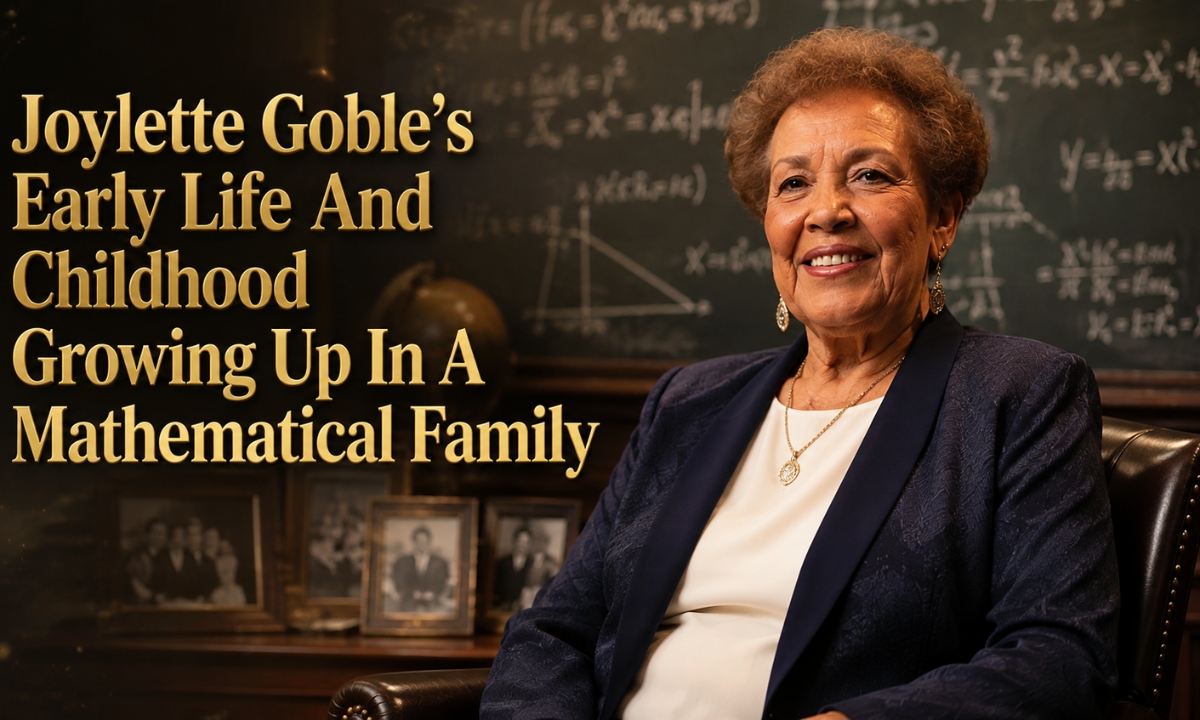
Joylette’s childhood unfolded in a home shaped by both restriction and opportunity. Segregation limited where the family could eat, shop, and travel. Yet inside their household, intellectual freedom ran wild. Katherine Johnson often said that numbers had no color and no gender, and she raised her daughters to believe it too.
The family settled in Newport News, Virginia, in 1953, after Katherine Johnson took a research job at what was then called the National Advisory Committee for Aeronautics, the agency that later became NASA. That move placed Joylette and her sisters close to NASA Langley Research Center, a place that would later play a role in Joylette’s own career.
Dinner conversations at the Goble household reportedly leaned toward logic puzzles and school lessons rather than gossip. Music also played a big role. Joylette and her sisters grew up singing in church choirs, an experience that later connected the family to important people, including Katherine’s second husband.
A few defining features of Joylette’s childhood stand out clearly:
- A strict focus on academic achievement in every subject, not just math
- Regular church involvement, which shaped both faith and community ties
- Early exposure to the idea that women could pursue mathematics education just as seriously as men
- A household untouched by the outside world’s assumptions about Black families during segregation
Newport News itself played a quiet but important role in shaping Joylette’s worldview. The city sat at the center of American aerospace research during the early Space Race, home to engineers, technicians, and scientists working on some of the country’s most ambitious projects. Growing up nearby meant Joylette regularly saw neighbors and family friends employed in technical fields, long before she understood the scale of what they were building.
School added another layer to her early education. Segregated classrooms often meant fewer resources than white schools received, yet teachers in these communities frequently pushed students harder, aware that Black children needed to work twice as hard to access the same opportunities. Joylette has described this environment as demanding but supportive, a place where academic achievement was treated as both a personal goal and a form of quiet resistance against racial barriers.
The Influence Of Katherine Johnson On Joylette Goble’s Life
Katherine Johnson worked at NASA Langley Research Center from 1953 until her retirement in 1986, performing complex mathematical calculations used in real spaceflight missions. Her trajectory work supported John Glenn’s orbital flight in 1962 and later contributed to planning around the Apollo 11 moon landing.
For years, Joylette had little idea just how important her mother’s job actually was. Katherine rarely discussed the details of her classified projects at home. What Joylette did witness, up close, was her mother’s discipline. Katherine balanced full time work at NASA with raising three daughters, first as a widow and later within a blended family.
That example left a mark. Joylette has spoken about growing up watching her mother handle setbacks calmly, whether professional or personal, and treating every challenge as a problem that could be solved with patience and logic. It is a mindset she carried directly into her own mathematics career and later engineering work.
As Katherine Johnson herself often put it, girls are capable of doing everything men are capable of doing. That belief was not a slogan in the Goble household. It was the daily operating rule.
Joylette Goble’s Family Background: Her Parents And Siblings
Joylette was born to Katherine Coleman Johnson and James Francis Goble, the eldest of three sisters. Her siblings are Constance Goble and Katherine “Kathy” Goble Moore. All three girls grew up close in age and remained connected throughout their lives, especially as public interest in their mother’s NASA work grew decades later.
Here is a simple breakdown of the immediate Goble family:
| Family Member | Relationship | Known For |
| Katherine Coleman Johnson | Mother | NASA mathematician, subject of Hidden Figures |
| James Francis Goble | Father | Educator, family’s early academic influence |
| Joylette Goble Hylick | Eldest daughter | Mathematician, engineer, author |
| Constance Goble | Middle daughter | Private family life, family advocacy |
| Katherine “Kathy” Goble Moore | Youngest daughter | Educator, guidance counselor, author |
| James A. Johnson | Stepfather | Korean War veteran, Katherine’s second husband |
James Francis Goble died in December 1956, when Joylette was still a teenager. Three years later, in 1959, Katherine Johnson married James A. Johnson, a United States Army veteran of the Korean War. The two reportedly met at choir practice at Carver Memorial Presbyterian Church in Newport News. That marriage lasted sixty years, until James A. Johnson’s death in March 2019.
James Francis Goble: Joylette’s Father And Academic Influence
James Francis Goble is often described as a steady, education focused father who valued learning as much as his wife did. Reports describe him as involved in shaping the family’s academic environment during Joylette’s early years, before his death from an inoperable brain tumor in 1956.
His passing came as a shock to the family. Joylette and her sisters had reportedly been shielded from the seriousness of his illness, which made his death feel sudden and harder to process. Katherine Johnson, now a widow with three young daughters, continued working full time at NASA Langley Research Center while raising the girls largely on her own for the next few years.
That period tested the family in ways few people at the time understood. Yet it also became one of the clearest examples of resilience that Joylette would carry into adulthood. Watching her mother keep working, keep parenting, and keep moving forward after such a painful loss shaped how Joylette would later face her own professional and personal challenges.
Joylette Goble’s Sisters And Family Relationships
Joylette, Constance, and Katherine “Kathy” Goble Moore grew up as a tight unit, bonded by shared loss, shared achievement, and a shared mother whose story would eventually become world famous. Each sister took a slightly different path in adulthood, yet all three carried forward the family’s emphasis on education.
Their relationship became especially visible to the public after the release of Hidden Figures in 2016, when all three daughters began appearing together at tributes, screenings, and family related events honoring their mother’s NASA history. Reporters and NASA historians alike have noted how united the sisters remained, decades after their shared childhood in Newport News.
Constance Goble: The Adventurous Middle Sister
Constance Goble is the middle daughter of Katherine Johnson and James Francis Goble. Public information about Constance remains limited, since she has generally kept a lower public profile than her sisters. What is known points to a woman who shared her family’s values around education and resilience, while carving out her own private path away from cameras and interviews.
Constance has reportedly joined her sisters at select tributes honoring their mother, particularly around milestone recognitions such as the Presidential Medal of Freedom ceremony in 2015 and later Hidden Figures related events. Her role within the family appears centered on support rather than public advocacy, a choice that fits the family’s broader respect for privacy.
Katherine “Kathy” Goble Moore: Continuing The Family’s Educational Tradition
Katherine “Kathy” Goble Moore is the youngest of the three Goble sisters and one of the most publicly active in preserving her mother’s legacy. She attended Bennett College and Hampton University before earning a Master of Science in Information Systems from Montclair State University, formerly known as Montclair State College.
Kathy spent 33 years working in public education in New Jersey, serving as both an educator and a guidance counselor. That career path reflects the same commitment to learning that shaped her entire family, just applied inside classrooms rather than laboratories. She currently resides in Greensboro, North Carolina.
Alongside her sister Joylette, Kathy co-authored two books drawing on their mother’s life story, including a title aimed at introducing Katherine Johnson’s achievements to young readers. In interviews, Kathy has described feeling privileged to call Katherine Johnson her mother, while also admitting that, growing up, the family did not fully grasp how historically significant her NASA work actually was.
Joylette Goble’s Education: Building Her Own Path In Mathematics
Joylette pursued mathematics at Hampton University, then known as Hampton Institute, a historically Black university with a long record of producing scientists, engineers, and educators. Entering around the late 1950s, she studied logical reasoning, applied problem solving, and core mathematical theory, the same academic foundation her mother had built decades earlier.
After completing her undergraduate degree, Joylette continued her education at Drexel University in Philadelphia, where she earned a graduate degree focused on information systems. That combination, pure mathematics paired with formal technology training, positioned her well for a career that blended scientific education with practical engineering work.
A quick look at her academic path:
- Bachelor’s degree in mathematics from Hampton University
- Graduate studies in information systems at Drexel University
- Continued professional development through her later NASA and Lockheed Martin roles
This educational background mirrors a broader pattern common among Black women mathematicians of her generation, many of whom combined historically Black college training with graduate work at larger research universities to break into technical fields still dominated by men.
Hampton University itself deserves credit here. As one of the oldest historically Black universities in the country, it built a reputation for producing scientists, educators, and engineers who went on to shape American institutions well beyond the campus. Joylette’s time there placed her inside a community that expected excellence, much like her home life had already trained her to expect from herself.
Her decision to pursue information systems at Drexel University also reflected good timing. As American industry shifted toward computing and data driven decision making during the later twentieth century, professionals who understood both classical mathematics and modern information systems found themselves well positioned for long term career growth. Joylette’s graduate training gave her exactly that dual foundation, one rooted in theory, the other in applied technology.
Joylette Goble’s Career: From NASA Langley To Engineering Success
Joylette’s professional path followed her mother’s footsteps almost literally. She worked as a mathematician at NASA Langley Research Center, the very facility where Katherine Johnson performed her most famous calculations for the American space program. This was not a symbolic gesture. Joylette held a genuine technical role supporting aerospace research during a critical period of the Space Race.
Later in her career, Joylette moved into the private sector, joining Lockheed Martin as a Senior Requirements Engineer. That role required strong analytical thinking, deep technical skills, and the ability to translate complex engineering principles into workable project requirements, skills she had been building since her Hampton University days.
Here is a simplified timeline of her career:
| Career Stage | Role | Organization |
| Early Career | Mathematician | NASA Langley Research Center |
| Later Career | Senior Requirements Engineer | Lockheed Martin |
| Present Focus | Author, STEM advocate | Independent |
Her career stands as a real world example of how mathematics education can open doors across multiple industries, from government aerospace research to private sector technology professional roles. It also reinforces a broader truth about women in STEM, showing that talent developed at home and in the classroom can translate directly into decades of engineering career success.
Working at NASA Langley Research Center placed Joylette inside an institution still processing the cultural shift her own mother had helped create. By the time Joylette arrived professionally, more women and more African American employees were entering technical roles across NASA, a shift her mother’s generation had fought hard to open up. In many ways, Joylette’s career benefited directly from the racial barriers and gender discrimination her mother had pushed against decades earlier.
Her later move to Lockheed Martin also reflects a common trajectory for engineers with government research backgrounds. Defense and aerospace contractors often recruit heavily from NASA and similar agencies, valuing employees who already understand strict technical standards and complex project requirements. As a Senior Requirements Engineer, Joylette would have worked closely with technical teams to define exactly what systems needed to accomplish before engineers began building them, a role demanding both mathematical precision and strong communication skills.
Joylette Goble’s Life Outside The Spotlight
Despite her family’s growing fame after Hidden Figures, Joylette has largely kept her personal life private. She currently resides in Mount Laurel, New Jersey, and has avoided the kind of public exposure that often follows relatives of historical figures.
This choice appears intentional rather than accidental. Joylette has appeared at public events tied specifically to honoring her mother, such as museum ceremonies and educational programs, but she has not sought a personal media career or built a public persona separate from that purpose.
That balance, present when it matters, private the rest of the time, reflects values she likely absorbed growing up in a household that respected discretion even while achieving extraordinary things.
Joylette Goble’s Role In Preserving Katherine Johnson’s Legacy
Since Katherine Johnson’s death in February 2020 at age 101, her three daughters have taken on the role of protecting and sharing her story accurately. Joylette has been especially active in this effort, working alongside Kathy Goble Moore to document their mother’s life in ways textbooks alone could never capture.
Some concrete ways Joylette has contributed to preserving the family legacy include:
- Co-authoring books that translate her mother’s NASA career into stories accessible for children
- Attending museum events, including portrait unveilings honoring Katherine Johnson’s contributions to NASA history
- Supporting accuracy in public retellings of her mother’s story, including corrections to common misconceptions
- Participating in educational programs connected to STEM outreach for young students
One clear example came in December 2016, when Joylette spoke publicly following the unveiling of a portrait of her mother at the Smithsonian’s National Museum of African American History and Culture, ahead of a special screening of Hidden Figures. That appearance marked one of the rare moments Joylette stepped fully into public view, specifically to honor her mother’s scientific achievement.
Preserving a historical legacy accurately takes real effort, especially once a story reaches Hollywood. Films often compress timelines, combine characters, or simplify events for dramatic purposes. Joylette and her sisters have taken on the quiet responsibility of clarifying details where needed, making sure their mother’s actual scientific contributions, not just the movie version, remain part of the historical record. Organizations such as West Virginia University Libraries, which maintain the Katherine Johnson Papers, have also played a role in preserving primary documents connected to her career, giving researchers and historians access to material beyond what any single film could capture.
This kind of legacy work rarely makes headlines, yet it matters enormously for historical accuracy. Future students researching NASA history, the American space program, or the broader story of African American history in science will rely on these preserved records far more than on any single movie adaptation.
How Hidden Figures Changed The Recognition Of Katherine Johnson’s Story
Before 2016, Katherine Johnson’s name was barely known outside NASA history circles, despite her critical mathematical calculations supporting orbital flight missions and the broader American space program. That changed dramatically with the release of the Hidden Figures movie, based on Margot Lee Shetterly’s book of the same name, which told the story of Katherine Johnson alongside fellow NASA mathematicians Dorothy Vaughan and Mary Jackson.
The film introduced millions of viewers to the reality of racial barriers and gender discrimination faced by African American women working in scientific fields during the mid twentieth century. It also, almost as a side effect, introduced audiences to Katherine Johnson’s family, including her daughters.
For Joylette personally, the sudden fame brought mixed emotions. On one hand, she and her sisters finally watched their mother receive recognition many felt was decades overdue. On the other, it meant navigating a level of public interest the family had never experienced before, even after Katherine Johnson received the Presidential Medal of Freedom back in 2015.
The table below highlights key milestones connecting Katherine Johnson’s recognition to public awareness of her family:
| Year | Event | Significance |
| 2015 | Presidential Medal of Freedom awarded | First major national recognition |
| 2016 | Hidden Figures movie released | Global audience learns her story |
| 2016 | Smithsonian portrait unveiling | Joylette speaks publicly |
| 2019 | James A. Johnson passes away | Family faces new personal loss |
| 2020 | Katherine Johnson passes away at 101 | Daughters become legacy stewards |
| 2021 | One Step Further published | Daughters co-author family memoir |
Joylette Goble’s Advocacy For Women And Young People In STEM

Joylette’s advocacy work centers on encouraging young people, especially girls and students of color, to pursue mathematics education and broader STEM careers. Her approach favors direct engagement over broad public campaigns, focusing on school visits, book projects, and small scale mentorship rather than large media platforms.
This advocacy connects naturally to her own history. She did not simply inherit a story about women in science, she lived one. By combining her mother’s NASA history with her own engineering career, Joylette offers young people a rare two generation example of sustained achievement in scientific fields long shaped by racial barriers and gender discrimination.
A few themes consistently show up in Joylette’s public messaging around educational advocacy:
- Mathematics is not reserved for any one gender or race
- Family support at home matters just as much as classroom instruction
- Careers in aerospace engineering and technology remain open to students who build strong technical skills early
- Representation, seeing someone who looks like you succeed in science, changes what students believe is possible for themselves
Educational advocacy connected to the Goble family has also grown through published work. Alongside Kathy Goble Moore, Joylette helped produce children’s books that translate their mother’s mathematical career into stories young readers can actually understand. Titles built around Katherine Johnson’s journey introduce basic mathematical concepts alongside lessons about perseverance, giving teachers a classroom ready tool for discussing both STEM education and American space program history in an age appropriate way.
This kind of grassroots educational advocacy tends to produce results that large scale programs sometimes miss. A single school visit or a well written children’s book can spark genuine curiosity in a student who might never encounter an aerospace engineer in daily life otherwise. For Joylette, that personal, direct approach reflects the same values her own parents used decades earlier inside their Newport News home.
Joylette Goble’s Legacy: More Than Katherine Johnson’s Daughter
It would be easy to describe Joylette Goble purely in relation to her mother. That framing, while understandable given Katherine Johnson’s historical legacy, misses much of what makes Joylette’s own story worth telling. She built a genuine mathematics career, transitioned successfully into aerospace engineering work at Lockheed Martin, and later became an author in her own right.
Her legacy today operates on two levels. First, she stands as a direct continuation of her mother’s scientific achievement, proof that the values instilled inside the Goble household produced more than one accomplished mathematician. Second, she has become an active protector of accurate history, ensuring Katherine Johnson’s story reaches new generations without losing important nuance or context.
As one family friend once put it during a tribute event, the Goble sisters did not just inherit their mother’s name, they inherited her discipline, and that discipline shows up in everything they have chosen to do since.
Fast Facts About Joylette Goble
- She is the eldest of three daughters born to Katherine Coleman Johnson and James Francis Goble
- Reportedly born around 1940, though exact records remain unconfirmed publicly
- Studied mathematics at Hampton University, then known as Hampton Institute
- Earned a graduate degree in information systems from Drexel University in Philadelphia
- Worked as a mathematician at NASA Langley Research Center, the same facility where her mother worked
- Later became a Senior Requirements Engineer at Lockheed Martin
- Co-authored family memoirs about her mother’s life, including One Step Further
- Spoke publicly at the 2016 Smithsonian portrait unveiling honoring Katherine Johnson
- Currently resides in Mount Laurel, New Jersey
- Continues active involvement in preserving her mother’s legacy and supporting STEM education
Final Thoughts
Joylette Goble’s story deserves attention on its own terms, not only as a footnote inside her mother’s remarkable biography. She turned a childhood shaped by mathematics, faith, and discipline into a genuine career at NASA Langley Research Center and later Lockheed Martin.
Today, she carries her mother’s legacy forward through books, public appearances, and quiet advocacy for STEM education. Her life proves that scientific achievement can run through an entire family, not just one historic figure, and that quiet persistence often builds legacies just as lasting as fame ever could.

Emma Carter is a language researcher and content writer with a passion for making English words and expressions easy to understand. She creates well-researched, reader-friendly guides that explain meanings, usage, and language nuances with clarity. Her goal is to help readers improve their vocabulary and communicate with confidence through accurate, reliable content.
